Platform architecture and controlled AI
How SXP.ai delivers governed AI automation at every layer: orchestration, intent routing, micro-agent scoping, model flexibility, deployment, and the governance that keeps AI safe and accurate by design. Rather than open-ended agentic AI, every capability is a scoped micro-agent.
Built on AWS
SXP.ai is hosted entirely on Amazon Web Services and is an AWS Validated Partner - giving universities enterprise-grade resilience, security, and UK/EU data residency from day one. Full security and compliance details are in our Trust Centre.
How the platform controls AI at every layer
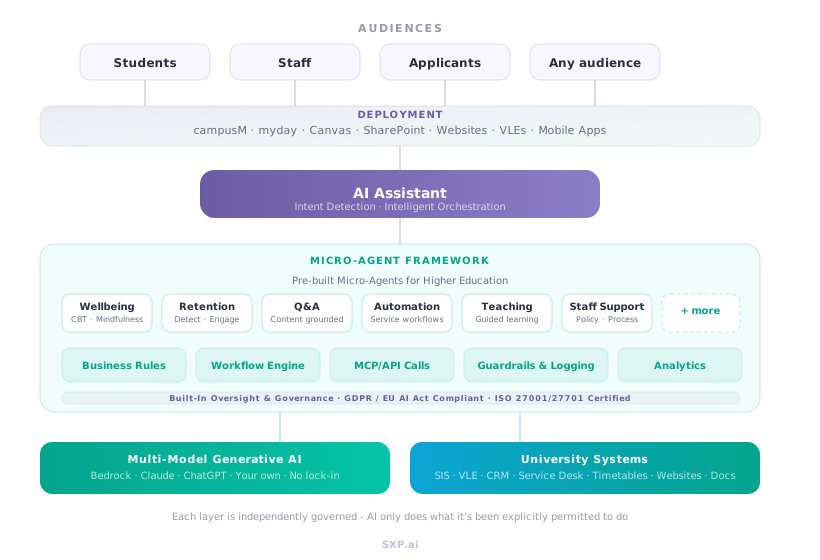
SXP.ai separates orchestration, intent routing, micro-agent capability, content scoping, model selection, and institutional systems into distinct governed layers - so AI only ever does what it's been explicitly permitted to do.
Reference architecture
What this enables
- ✓ One orchestration layer that routes input to purpose-built micro-agents
- ✓ Capability added safely - without widening what AI can access or do
- ✓ Campus systems connected through governed micro-agents
- ✓ Model choices that evolve over time without re-architecting
- ✓ Content scoped per capability and audience
Intent detection & routing
Whether input arrives as a conversation, an email, or a system event, the platform detects intent and context, then routes to the right micro-agent - so every response is scoped, relevant, and aligned to approved institutional content.
One orchestration layer, many capabilities
The orchestration layer selects the right micro-agent based on what's needed, who's asking, and which channel is in use - whether the input is a user conversation or an inbound system event.
- ✓ Routes by intent, audience, channel, and policy
- ✓ Each audience gets a tailored experience
- ✓ Every response comes from a scoped capability
Scoped content and responses
Each capability is grounded in approved institutional content. Content sources are scoped per capability and audience - so a student-facing capability doesn't surface internal staff policies.
- ✓ Content scoped per capability and audience
- ✓ Grounded in institutional websites, documents, and knowledge bases
- ✓ No cross-contamination between audiences
Micro-agents for controlled AI
Micro-agents are how SXP.ai delivers fine-grained control. Each one performs a defined function with its own scope, permissions, and rules - so capability grows without widening what AI can do, say, or access.
Orchestrates the agentic ecosystem
Universities are deploying multiple agentic platforms - Salesforce, ServiceNow, Microsoft, Canvas, and more. SXP.ai orchestrates across them under one HE-specific governance model - calling and consuming external agents through its Agent & System Connectors layer, governed the same way as every other capability.
- ✓ Connects to external agents via REST APIs, Webhooks, MCP & A2A
- ✓ All external agent calls governed, logged, and auditable
- ✓ SXP.ai capabilities can themselves be called by other agents
Guardrails and safe usage
Micro-agents operate within defined scope, with multiple layers of control - from architectural constraints to conversation-level guardrails - supporting safe operation in sensitive and high-risk contexts.
- ✓ Scoped access & permissions
- ✓ Business rules and workflow controls
- ✓ Logging and auditability
- ✓ Human follow-up and escalation pathways
Pre-built micro-agent library
Pre-built micro-agents for common higher education use cases - enabling rapid deployment with minimal configuration.
- ✓ Wellbeing support & structured journeys
- ✓ Retention patterns & proactive engagement
- ✓ Teaching & learning support
- ✓ Q&A over websites, documents, and knowledge bases
- ✓ Service automation
Custom micro-agents
Additional micro-agents can be configured or delivered as separately scoped professional services - maintaining clear governance, cost control, and delivery assurance.
- ✓ Separately scoped delivery and acceptance criteria
- ✓ Explicit permissions and data access design
- ✓ Operates under the same oversight and logging model
Deployment and integration
SXP.ai fits into your existing digital estate. Users authenticate through your identity provider, capabilities deploy wherever your users already are, and micro-agents connect to campus systems through governed connectors.
Deploy anywhere
Conversational Assistants embed into your existing website, student portal, or VLE - or run as a standalone full-screen experience. Automated workflows run wherever the work is.
- ✓ campusM, myday, SharePoint, and institutional portals
- ✓ VLE/LMS integration via LTI where applicable
- ✓ Automated workflows triggered by systems and events
Identity & authentication
Integrates with your existing identity provider so users authenticate once. Responses are tailored to role, cohort, or entitlement.
- ✓ SAML 2.0 and OpenID Connect (OIDC)
- ✓ Role-based access and audience segmentation
- ✓ Supports authenticated and anonymous modes
Agent & system connectors
Micro-agents connect to institutional systems and external agents to retrieve information and trigger workflows - via REST APIs, Webhooks, MCP, or A2A - without exposing those systems directly to AI.
- ✓ Service management platforms (e.g. TOPdesk, ServiceNow)
- ✓ Student information systems and CRMs
- ✓ External agents via MCP and A2A protocols
- ✓ Workflow triggers and case handling
Content & knowledge management
Capabilities are grounded in your approved content. Knowledge sources are managed centrally and kept up to date without retraining models.
- ✓ Websites, PDFs, knowledge bases, and documents
- ✓ Managed ingestion with version control
- ✓ Content scoped per capability and audience
Model flexibility without lock-in
The platform is model-agnostic by design. Micro-agents can operate across Amazon Bedrock, Claude, ChatGPT, or institution-provided models - allowing you to choose, mix and change models as the landscape evolves.
No vendor lock-in
Choose models that align with policy, risk appetite, data residency, and cost - and change those choices over time as governance evolves.
- ✓ Bedrock-first deployments available
- ✓ External LLM support where approved
- ✓ Ability to adopt new models safely
Policy-driven selection
Model choice is implemented within the governed architecture - supporting central IT oversight and reducing fragmentation.
- ✓ Platform-level controls
- ✓ Consistent governance enforcement
- ✓ Repeatable implementation patterns
Governance, compliance, and responsible AI
EU AI Act governance, risk management, and oversight controls - including high-risk controls, applied as standard across all personalised use cases - are embedded directly into the platform. This removes the need for universities to design bespoke AI governance frameworks for each new use case.
Built-in oversight
Oversight, policy enforcement, logging, and auditability are embedded at every layer - built in, not bolted on.
- ✓ Guardrails and logging by design
- ✓ Defined escalation pathways to human support
- ✓ Visibility into micro-agent behaviour and decisions
- ✓ EU AI Act high-risk controls applied as standard
Security and certification
Delivered on AWS infrastructure under certified information security and privacy management systems - giving universities a defensible compliance posture out of the box.
- ✓ ISO/IEC 27001 certified
- ✓ ISO/IEC 27701 certified
- ✓ Cyber Essentials certified
- ✓ GDPR compliant
- ✓ EU AI Act compliant
Live in weeks
SXP.ai is delivered through packaged services - not left to your team to configure and deploy. Universities get production-ready AI automation without needing internal AI engineering capacity.
What SXP.ai delivers
Pre-built micro-agents, agent configuration, content ingestion, deployment, and ongoing platform operation - delivered as a managed service.
- ✓ Pre-built HE capabilities ready to deploy
- ✓ Agent branding, scoping, and configuration
- ✓ Content ingestion and knowledge base setup
- ✓ Deployment into your channels and platforms
What your team provides
Access to content sources, stakeholder input on scope and audiences, and sign-off on governance and deployment - everything else is handled by SXP.ai.
- ✓ Content and knowledge source access
- ✓ Audience and scope requirements
- ✓ SSO / identity provider configuration
- ✓ Governance sign-off
See how it works
A walkthrough tailored to your institution - whether you want a quick overview or a deep dive into platform architecture, governance, and deployment.